

A History of Zoroastrianism from Zarathushtra to Darius
The history of Zoroastrianism[1] is a very long and convoluted topic, stretching across many different eras, often with few surviving sources. While intended as a universal religion, an intrinsic nature that it kept for at least a millennia, its history would increasingly become intertwined with the history of Iran. The history of both, in fact, is characterized by periods of greatness, with major advancements in philosophy, science, and civilization that are followed by periods of darkness and destruction, typically caused by foreign invasion. The reason for this, it seems, is that for all its history, Iran has sat at the center of the world. So, in times of strength, it was able to spread its influence all across the world, from China, the great steppelands, and India, to Mesopotamia, Greece, and Egypt. But in times of weakness, it would find itself overextended, with enemies surrounding it from nearly all sides.
The Age of Zarathushtra (1500–1000 BC)[2]
The history of Zoroastrianism, as well as Iran, begins with Zarathushtra–the message he taught, the life he lived, and, significantly, the environment in which he lived. At this time, ancient Iran was an early Iron-age pastoral society occupying the region of Bactria-Margiana, in modern day Central Asia. Archaeologically, this society is known as Yaz I (~1400-1000 BC), and is characterized as the Iranian culture which had replaced the earlier, non-Iranian BMAC culture (2250-1700 BC) after its collapse.[3] The people lived in small settlements on key spots of an extensive irrigation system which they primarily used as pasturage for their herds of horses, cattle, and other livestock. Politically, they were decentralized, ruled over by a collection of chieftains, or petty lords, whose power and wealth were measured in their possession of chariots, horses, and precious metals mined in the nearby Pamir mountains. These lords were often violent and aggressive, frequently raiding innocent people for wealth and territory.
The religion of ancient Iran was very similar to its counterpart of Vedic Hinduism, with a plethora of deities presiding over natural forces, all representing a rich mythology inherited, and subsequently innovated on, from the Proto-Indo-European religion. These gods were referred to as daēvas, with many of the greatest ones being given the title of ahura ‘lord’ or ‘supreme’[4]; they were worshiped at significant ceremonies where priests would recite large amounts of precomposed, oral poems in honor of the gods, sacrifice animals, present offerings such as butter, libations, or meat, and, in certain cases, engage in the ingestion of haoma (Vedic soma), a hallucinogenic drug that would allow one access to the spiritual realm. Haoma, made from a blend of ephredine and esfand/harmaline (functionally equivalent to ayahuasca),[5] would form a central part of this religion, with a special type of priests who preceded over the preparation and usage of it. These priests were split in two classes, the karpans, who prepared the haoma and performed the ritual, and the kavis, who would take the haoma and thus ‘perceive’ the other realm, hence the name.[6]
Interestingly, by the age of Zarathushtra, the Kavis, with the Karpans at their side, had taken political power in Iran, acting both as secular lords and priests. Together, they had formed a sort of religio-political class which dominated the many small, disconnected fiefdoms of ancient Iran. On one hand, they restricted the consumption of haoma and, by extension, the connection to the divine to themselves, and, on the other hand, they wielded their newfound status as lords to grow ever wealthier at the expense of the common person. Such was their status, that after a certain point the term Kavi came to specifically refer to a king in the time before Zarathushtra.
Despite the tyranny of the Kavis and Karpans, there seems to have existed alongside it a strong undercurrent of intellectualism, mysticism, and philosophy. This tradition was characterized by a more mystical approach to the gods and religion, efforts to accurately understand the metaphysical nature of reality, and, most importantly, attempts to reach and understand the divine.
Above all else, this tradition valued wisdom and the improvement of the mind, seeking to invoke ‘enlightenment’ or ‘revelation’ through repeated study and self improvement. One of the key ways this was accomplished was through the memorization, repetition, and subsequent study of highly intricate philosophical poems called manthras. The poets who composed these were called manthrans, and they often founded schools where many students would study under the manthran, seeking to find the same wisdom and understanding the manthran sung about. Alongside the manthran, there also existed a type of priest called a ratu, which were sages that acted as spiritual guides to individuals and communities; while their responsibilities were somewhat different than the lifelong searching of the manthrans, they still continued this intellectual tradition. Ratus often saw themselves in charge of the wellbeing of a group of dependants, typically referred to as gaе̄θā ‘living creature’, caring for their physical and spiritual wellbeing, adjudicating disputes, and dispensing both advice and judgment for transgressions.
It is within this environment, a society so capable of advancements in civilization and thought yet hampered by superstition and short-sightedness, in which Zarathushtra arose. He was born in a spacious home on the Darji river, potentially in the nation of Ragi[7], some 278 years before some calamity hit ancient Iran; while neither dates can be determined, a tentative date around 1200 BC can be supposed based on certain archaeological evidence.[8] His father was Pourushāspa Spitāma, a hot-headed and braggadocious man who was a wealthy horse owner and the lord of a village and the surrounding land; his mother was Dughdova, a somewhat mysterious figure who seems to have had a significant impact on Zarathushtra.
Dughdova was the daughter of Zoish and Frahimurvana, and was known for having a bright and remarkable character, with legend even attributing to her a luminous glow that dazzled all around. While the details are uncertain, she seems to possibly have been a free-thinker who practiced a non-standard type of religion. When she was still young, her region was hit with multiple disasters, including the appearance of invaders; the people, perhaps due to her reputation, blamed these events on her practicing witchcraft and informed the Karpans of the issue. Her father vigorously sought to defend her, but fearing reprisal from the Karpans, sent her to a neighboring land to live in the house of Padiragtarāspa,[9] a local ruler. It is said that when she reached near this town, she climbed the tallest point and surveyed the town, which spread all across the valley; there she saw her future husband Pourushaspa, the son of Padiragtarāspa, walking with the cattle. She suddenly heard a voice carried to her on the wind that told her this town would be compassionate to her. She realized then that her father’s decision was correct and headed into the village.
The two would eventually get married and have multiple children, including Zarathushtra. It is said in legend that upon his birth, he came out laughing, rather than crying, which frightened all the midwives, who questioned why a child would ever be born laughing. His father, witnessing the scene, exclaimed that it was on account of the virtue and magnificence of his mother that a child could be born laughing. Pourushaspa eventually called a local Karpan named *Dūrasravah (‘having far fame’) to inspect the child; this Karpan, perhaps upon seeing spots and marks on the baby, immediately called for Zarathushtra’s death. Pourushaspa, while initially dismayed, acquiesced and sought to go through with the infanticide, before Dughdova rushed to her son’s rescue and clung the child to herself, refusing to let go of the baby Zarathushtra. She rebuked her husband and kept the child from him for many years, rarely allowing him to see Zarathushtra.
In the early years of his life, Zarathushtra was raised primarily by his mother; although, his father may have played a more active role as he grew older. By the time he reached 15, he had become renowned for his sagacity, the broadness of his intellect, his love for the divine, and his strong sense of ethics. Moreover, he increasingly began to question the thoughts and beliefs of his time, especially the religion of the Karpans. This led to much conflict between the young Zarathushtra and the religious establishment of his day, with the Karpans regarding him as secretly corrupted and an enemy of their order. At the age of 20, without the consent of his parents, Zarathushtra left his home in search of greater knowledge and wisdom. It seems that he was greatly discomforted by the nature of his society–the false religion, the unethical rulership, the poverty and inequity, and the lack of truth. So he sought answers, both on how to right the wrongs of society and what the ultimate nature of reality was.
Initially, he traveled across the country, volunteering to help the poor and needy. After a few years, he went to an institution that was renowned for its wisdom and knowledge, likely one where manthras were composed and studied. Here, it is said that he was taught how to tend to ritual fires, how to press and prepare haoma, and how to worship the daevas with words containing insight.[10] Much of this training likely consisted of the meditation on manthras and poems in honor of the daevas along with the techniques of how to compose these manthras. While he was here, he was also instructed to help care for the herds of cattle they kept and to feed the poor. Eventually, however, he became dismayed with their worship of the daevas, and their reliance on the hallucinogenic drug haoma to reach the divine. And so he left, again in search of greater wisdom.
While the details are uncertain, it is said at the age of 30, while bathing in a river shortly before a festival, Zarathushtra was suddenly struck with some type of revelation, one in which he was able to commune with the divine. It is here that he first communed with Mazda Ahura and the Amesha Spentas, when the way the world was shaped was first told to him, and when he saw the true nature of reality. This would go on to be the defining moment of his life, where he first learned of the existence of Mazda and where his eyes were truly opened. He went from being a relatively unknown poet in a small corner of the world to the first human being to encounter ‘God’ and to be revealed truths far ahead of his time.
Over the next decade, Zarathushtra would continue to commune with Mazda while he desperately tried to teach his new ‘religion’, this system of understanding he learned from Mazda, to the people around him. He traveled far and wide, preaching to all he could. Many people were struck by the wisdom of his teachings and his upright and marvelous character. However, Zarathushtra strongly and clearly repudiated the daevas, the very gods the people of his day worshiped, denying them as the false and evil creations of misled minds.[11] Because of this, he received solely interest or sympathy from some and outright condemnations from others. In ten years, it is said he had only succeeded in bringing one person over to his cause, his cousin Maidyomāh. It was at this point, barely feeling like he found any success, that he reached the court of an important kavi named Vishtāspa.
Kavi Vishtāspa was the tall, young, and vigorous leader of the powerful Naotara clan, which claimed descent from the legendary figure of Manushchithra (Manuchehr). The primary resource of the clan was their numerous herds of cattle, although they also possessed many horses. Vishtāspa was seemingly a very competent chariot racer, who likely patronized and participated in many races on his estate. As the head of such a powerful clan, he was famous far and wide for his wealth, stature, and chariot-racing. Many people would come from all over to petition him, and he kept a diverse court of karpans, ratus, manthrans, and other supplicants. When Zarathushtra reached Vishtāspa court, he had attained 40 years of age, weathered by life but hopeful for the future.
It is said that when Zarathushtra first reached the court of Vishtāspa, he was met with great welcome. Vishtāspa was initially very interested in what Zarathushtra had to say, and he accepted him into his court so he could learn from his counsel and wisdom. However, many of the karpans in his court felt threatened by Zarathushtra and his message, specifically because he spoke against their worship of daevas, their use of haoma, and their exploitation of the common people. So, according to a legend, they devised 33 crafty riddles to test his intellect. He successfully answered 3 of these riddles, but, before he could answer any more, one of the karpans plotted to have Zarathushtra imprisoned by lying to Vishtāspa about his true character. Vishtāspa, being deceived on the matter, had Zarathushtra locked in a dungeon and left to die, with hardly any food or water to drink. After being locked in this dungeon, Zarathushtra was have purported to say:
“I have spoken about three of their inquiries, and I am bound by thirty of them,
I, with the thirty-three fetters of murderers, wicked ones, and daeva-worshippers,
But the hunger of mankind’s inclination violently affected the strength of my legs,
But the hunger of mankind’s inclination violently affected the force of my arms,
But the hunger of mankind’s inclination violently affected the hearing of my ears,
But the hunger of mankind’s inclination violently affected the sight of my eyes,
And it would wither away my chest until it was at my back,
Through the continuance of that deadly hunger of mankind’s inclination.”[12]
Legend says that when Vishtāspa and the karpans returned, expecting Zarathushtra to have certainly perished, they instead saw him miraculously healthy and vigorous. However, this is clearly legendary, and it is likely that Vishtāspa had either felt empathy for Zarathushtra or wisened up to the karpan’s plot and released Zarathushtra. The offending karpans were punished, and Zarathushtra was given the patronage of Vishtāspa. Over the next two years, Zarathushtra composed more of his manthras and began attracting more people to his teachings.
In this period of 2 years, Zarathushtra also spent much time with the young kavi Vishtāspa. It is said he taught him the very ways in which the worlds were ordered;[13] that he had bade the young king to look into the depths of a fire and told him that it is within fire that all of existence had been born. Zarathushtra also instilled within Vishtāspa a deep sense of morals and compelled him to feed the poor, telling him that on seeing the needy lined up at his door all his bread would become burning coal upon his head.[14]
Throughout this time period, it is said Zarathushtra tried three times to bring Vishtāspa over to his teachings. The first time, Vishtāspa complained that even if he accepted the religion, its benefit would not outweigh the many men he had slain in battle. Zarathushtra responded that these people were invaders seeking to harm their people, and that none of the heroes and kings of old escaped from killing their enemies. He instead says their fault was in not turning to Mazda and following the truth when they were given the opportunity. Still, Vishtāspa is not convinced.
The second time, Vishtāspa convened a council of the wisest and most learned ratus of the land to evaluate the validity of Zarathushtra’s teachings. These ratus were concerned about how Zarathushtra’s teachings may affect the people in their care and whether what he spoke was true. After a period of deliberation, they all become convinced of Zarathushtra’s teachings. However, not long before this time, Vishtāspa had received two envoys from a Hyaonian (Hunnish) ruler named Arjataspa, demanding tribute from him; so, on account of the worry in his soul, he was unable to accept it.
Finally, Zarathushtra tried for a third and final time to convert him. This time Vishtāspa, determined to evaluate this religion once and for all, ordered a preparation of haoma be brought to him. Vishtāspa took the drink and went into a deep slumber. While dreaming, he supposedly visited the higher realm of Mazda Ahura and the Amesha Spentas and marveled at what he saw. When he awoke from this mystical dream, he called to his wife Hutaosa in the middle of the night that Zarathushtra should be brought to them, so that he could accept the religion. From this point on, Vishtāspa vigorously supported Zarathushtra’s new religion, and encouraged all the people of his land and the surrounding lands to accept it.[15]
The Gathic Era (~1200–900 BC)
At this point, with the full backing of a powerful ruler, Zoroastrianism enters into the Gathic era, which is characterized by the early followers of Zarathushtra following the pristine Gathic teachings. Although technically, according to Avestan historiography, it maybe should be started on the date of Zarathushtra’s revelation, at age 30, 45 days past Nowruz (~April 25th); this is because the no longer extant Spand Nask of the Avesta contained a detailed chronology and history starting on the date of Zarathushtra’s revelation (much similar to the Gregorian calendar starting with the birth of Jesus).[16] From here on dates in the Gathic and Avestan periods will be dated from the date of Zarathushtra’s revolution. Regardless, the Gathic period is a crucial period of the history of Zoroastrianism, as it contains the creation of the Gathas and the early proliferation of Zarathushtra’s teachings across ancient Iran.
Regardless, at the age of 42, 12 years after his revelation, Zarathushtra suddenly found himself with the full backing of Vishtāspa, and in the position as his chief religious advisor. Vishtāspa, his wife Hutaosa, and much of the court and common people accepted Zarathushtra’s teachings. With this newfound support, Zarathushtra’s message began to reach a much wider audience; suddenly, people from all over ancient Iran came to hear him speak. His teachings were controversial, but also revolutionary and life-fulfilling. He taught them about the true nature of existence, the existence of a Supreme Intelligence which created reality, and about the struggle of good and evil in existence. He told them that the gods they had worshiped before, the daevas, were false and evil, and that the karpans and kavis were violent, deceitful parasites who exploited and oppressed them. He told them that rulers should be good and ethical, and rule by the explicit consent of the governed; he also told them that both men and women were equal and both should be allowed full autonomy over their lives, whether they be rulers or simply a common person.
It is in this environment that Zarathushtra likely started some sort of school and started crafting manthras for the purpose of educating his students. The result of this were the Gathas, 17 highly complex and intricate manthras; within them he integrated older, shorter poems he made earlier in his life.[17] In a sense the Gathas were the culmination of his whole life. His strategy with the Gathas, it seems, was to weave within as much wisdom and information in the smallest place possible, so that a student could find a wealth of information in merely a single stanza. At only around 5,500 words, it was short enough for even a dedicated follower to memorize and study in their lifetime. Moreover, the term Gatha, initially a style of religious poetry either sung or called out in a unique fashion, seem to exist outside of, or in opposition to, the religious establishment of the day, as this style was frequently utilized by mystics, nonconformists, and folk-practitioners who might have been labelled wizards or witches, such as Zarathushtra’s mother Dughdova.[18]
In this time period, Zarathushtra had many students, including the brothers Frashaoshtra and Djamaspa Hvogvo, the latter of whom became a treasured pupil of Zarathushtra. He also got married in this time period, and had a few children. Of these children, a daughter named Pouruchista (‘full of insight’) is known from the Gathas and another daughter named Freni seems likely to have existed.[19] Regardless, for many people, Zarathushtra would become a ratu, a sage and guide who showed them a new and life-inspiring way to live, but for a select few, for those of greater wisdom and intellect, he became a mentor who taught them how to reach and attain the divine in their own minds. This deeper, esoteric level of his teachings was also encoded into the Gathas, but as of today, this has not been fully explored.[20]
30 years after Zarathushtra communed with Mazda, when he was 60 years old, it is recounted in legend that a Xyoanian/Hunnish ruler named Arjat-Aspa formed a coalition of the other Xyoanian rulers for the purposes of invading and plundering ancient Iran. Again, the details are uncertain, but it seems these Huns had assimilated to Iranian culture and took offense to Vishtāspa’s rejection of the daevas, perhaps just an excuse. A massive war followed which saw much destruction; in the final battle, Vishtāspa’s own brother, Zairi-vairi, would die before the Iranians saw victory.[21]
After this victory, Vishtāspa focused on increasing and improving his dominion while Zarathushtra continued to teach his message. His daughter would eventually get married to an unnamed spouse, and Zarathushtra would dedicate his final Gatha to her wedding. He would also decide to name his system of understanding the world, which he had received from Mazda, as the Vanguhi Daе̄nā ‘the Good Envisionment’. This name would go on to be the core title of Zoroastrianism, even up to this day in Modern Persian Behdin, although it would later share names with the title mazdayasna ‘the worship of Mazda’. It is said, at the age of 77 years and 44 days, in the 47th year of Zoroastrianism, Zarathushtra would pass away, either peacefully in his sleep or at the hands of an antagonistic priest, depending on the legend.
After his death, Djamaspa would become the leader of the Good Envisionment for the next 17 years. He would be significantly helped by Freni, Zarathushtra’s eldest daughter, and Ashastu, the son of Zarathushtra’s cousin Maidyo-mah, both of whom are noted as playing an important role in the early stage of Zoroastrianism. In the 57th year of the religion, it is said that Vishtāspa made a pronouncement across all the lands about Zoroastrianism, which brought two seekers of knowledge, Spiti and Erezraspa, to study under Frashaoshtra. In the 63rd year, Frashaoshtra would pass away, and the following year his brother Djamaspa would follow. In the 100th year of the religion, it is said a man named Saena ‘the eagle’ was born, who would teach 100 students and live for 100 years. Finally, it is said in the 248th year, 278 years after the birth of Zarathushtra, some great calamity would come to ancient Iran and put it into a century of darkness.[22]
While this event would mark the end of the Gathic period, there are many other details regarding this period that are lost, although many of the names still survive in the Fravardin Yasht. This time period would see the standardization of the Gathas and its organization into the current format. The Gathas would be placed into a ritual with the creation of the (Yasna) Haptanghaiti, which was inserted in the middle. This text, while short, shows a very beneficial, nature honoring, and almost animistic style of Zoroastrianism that gives a key insight into how Zoroastrians practiced the religion at this time. The Haptanghaiti also shows some of the earliest evidence of key aspects of Zoroastrianism that are absent from the Gathas. The emanations of Mazda Ahura would be given the name of Amesha Spentas, mimicking a similar pattern of calling a set of deities Amesha/Amrita in Indo-Iranian religion;[23] Mazda Ahura would also begin to be called yazata ‘he who should be worshiped’ which, while generic at the time, would later go to serve as the model for reintegrating certain daevas into Zoroastrianism. This time period would also see the creation of the airyema ishyo prayer, the fshusho manthra, and perhaps at the very end prayers like the ashem vohu, yenghe hatam, and the Fravarane/ Zoroastrian creed, although these last 3 could belong to the period after cataclysm.
The Avestan Age (~850–550 BC)
This cataclysm which placed ancient Iran into a period of darkness, possibly a foreign invasion, is said to have taken place 278 years after the birth of Zarathushtra or near the beginning of the fourth century of the religion; while it is certainly possible that Zarathushtra lived longer than 278 years before this event, one may date this event around 900-800 BC with the burning of Ulug Depe and the transfer from Yaz IIA to IIB.[24] This period of darkness would last until the end of the 4th century of Zoroastrianism with the arrival of a figure named Ərəzuua, around the 400th year of Zoroastrianism. It is said he became the main authority in Zoroastrianism and was a powerful force in restoring the religion. Over the following two centuries, he would be followed by three other figures named Srūtō.spāda, Zraiiah, and Spəṇtō.xratu who would play important roles in the religion in the 5th and 6th centuries of Zoroastrianism, roughly from ~800-600 BC.
This period is called the Avestan Age, and it is dated from around 1000 BC to 330 BC. It overlaps to some extent with the Median and Achaemenid empires, but after 625 BC, the nature of Iranian civilization changed drastically. This age is characterized as a sort of decentralized feudalistic society with no centralized authority; instead the Iranians, or Airyans in their language, had a sort of civilizational horizon, with most conflict being with their foreign neighbors to the north, be they Xyonians/huns, Turanians, Dahae, or Sarimya/Sarmatians. The Iranians were split across a number of different nations spread across the regions of Central Asia. Of these nations, most notably were Margiana, Bactria, Sogdia, Xwarezmia, Hariava (Herat), Haetumant/Drangiana (Sistan), and Haraxwaiti (Arachosia). Despite this, the Iranian people lived a settled lifestyle in small cities, often with impressive citadels, evidenced by the pictures below of Ulug Depe, seemingly an Archaic-Parthian city.[25]
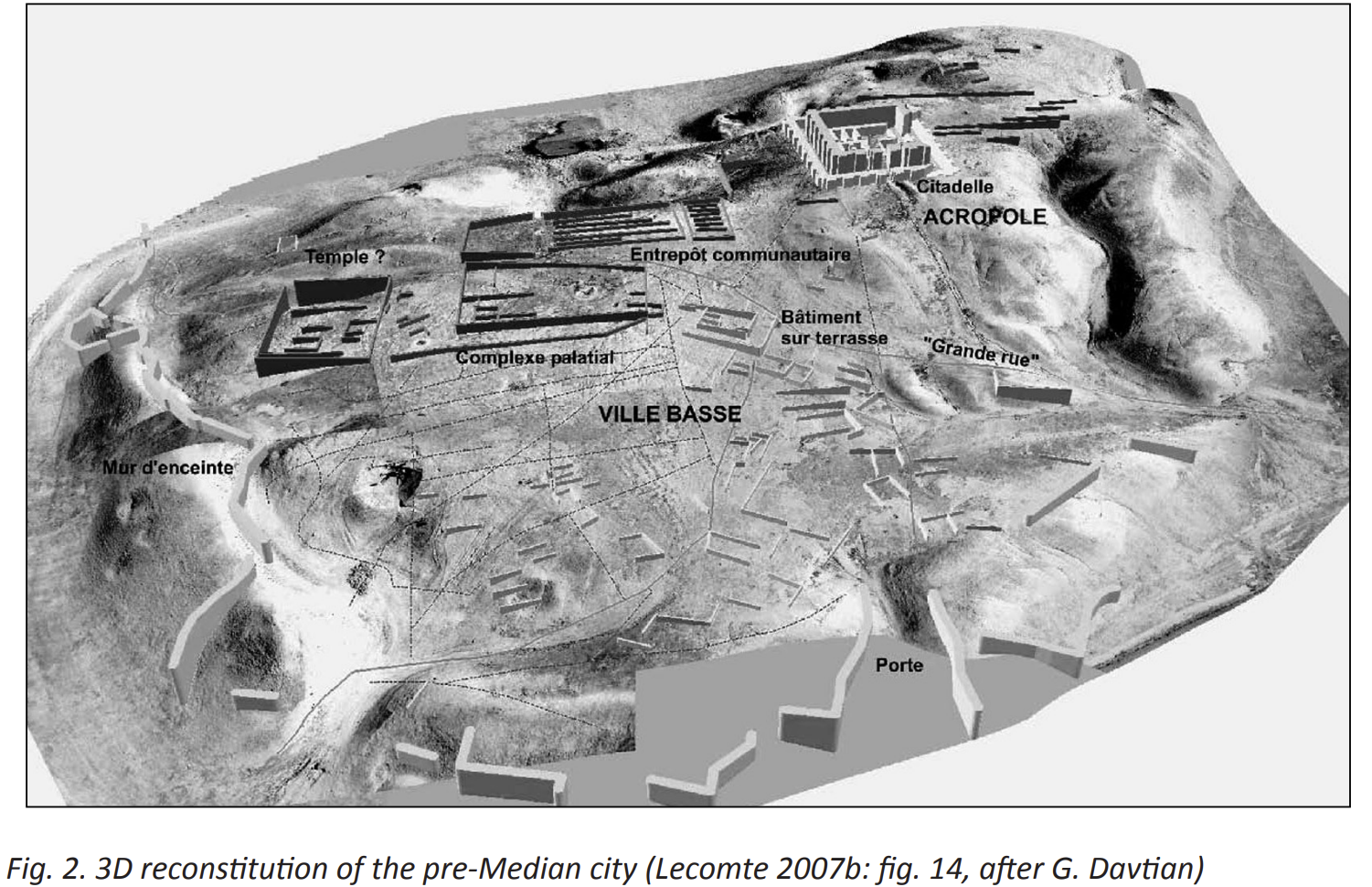
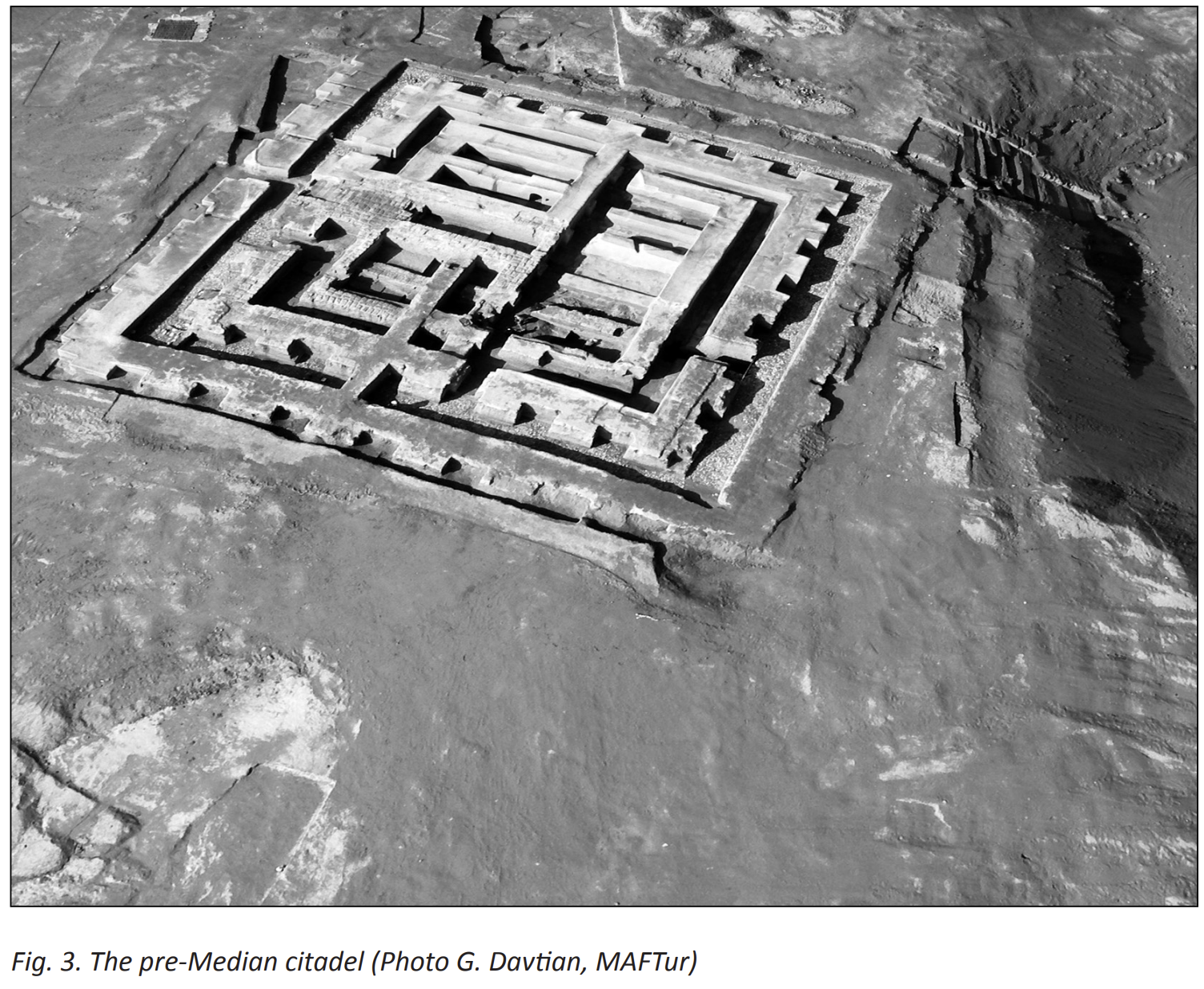
The Avestan age can be split into three rough divisions. The first is the early Avestan period, it is characterized by the 4th century period of darkness and the time immediately following it. It sees the language shift from the Gathic language (often called Old Avestan) to the distinct yet related Avestan language (typically called Young Avestan). This period also sees a remarkable shift in the religion as many ideas, gods, and beliefs of the Iranians are adapted into a new form of Zoroastrianism, one that is heavily syncretized from the previous religion. These previous gods, or daevas, were reincorporated as yazata-s ‘those which should/must be worshiped’ to distinguish them from the daevas which shouldn’t be worshiped; they were further qualified as creations and partners of Ahura Mazda, who would aid him in the management of the world. In a similar vein, the Amesha Spentas would each be given an aspect of creation to rule over, beginning to resemble more traditional deities than the abstract concepts they initially represented. Furthermore, ritual purity laws and the exposure of the dead would also become a staple part of the religion, likely borrowed from the previous beliefs. Of the Avestan works dating from this early period, it is likely that many parts of the epic yashts were first composed; although, given this is a period of transition, most of the works likely date after it, even if they had precedence in something composed in this time period. An exception to this could perhaps be the Bagam Nask (today only extant in Yasna 19-21) which has a more archaic form of language compared to other texts, although this is not certain as it could still date to the following period. Short texts in Middle Avestan, or Archaizing young Avestan (e.g., Fravarane or Yenghe Hatam), likely date to this period. Geographically, this period sees the Iranian stay mainly to the north of the Hindu Kush mountains, encompassing the nations of Bactria, Margiana, Xwarezmia, Sogdia, and Haraiva,[26] along with two lesser known nations called Pouruta and Ishkata.
The following middle Avestan period can be dated from ~750-550 BC. It sees the creation of a standardized and internally consistent religious, mythological, and theological system. What one typically understands as Zoroastrianism is officially formulated in this time period. It sees the complete formulation of Avestan theology, Ahura Mazda sits at the top, followed by the Amesha Spentas, the twin mainyus, and finally the yazatas and daevas. The religion in this time also becomes much more mythologized, with daevas becoming demonic and polluting forces in the world rather than false gods, and Zarathushtra’s life and origin becoming more magical than historical. This period also sees the formulation of a complex creation story; which in effect, is a merger of Zarathushtra’s account of Mazda Ahura and the twin mainyus enacting it in the world with much older ideas of the primordial cow and the first man. A detailed eschatological account is also found, with three successive saoshyants who would preside over the iterative perfection of existence.
The Gathas and a few related works are canonized into the 33 chapter Staota Yesnya, while the rest of the Avestan texts are merely contemporary works in the process of composition. Geographically, this period would see the Iranian peoples spread further south, into central and southern Afghanistan and into northern Pakistan. Of these new lands, the nations of Haetumant/Drangiana, in modern day Sistan, and its neighbor Haraxwaiti (Greek Arachosia) would increasingly become more important. However, the most important of these nations was the powerful Margiana, or Mouru, (Merv) which was centered on the fertile murghab oasis, and it likely had a strong impact on which language and interpretations made it into the Avesta. Of the Avestan texts composed in this period, the Yashts, or more properly Bayan-yasn, were certainly composed, reworking earlier yasnas in honor of certain gods. The related Chihrdad Nask would also be composed, reworking earlier legends of great Iranian heroes into a new Zoroastrian mythos. Other books like the Hadaoxta Nask, a large collection of religious poetry; the Ratushtaiti, a guide book for ratus; and the Sudgar, a collection of myths tied to the gathas, were likely composed in this time, along with many other books.
The following can be called the late Avestan period, although, as it overlaps with the Achaemenid empire, it is typically considered part of the Achaemenid empire. The end of the previous period had seen the sustainment of roughly two centuries of prosperity where the Iranians had established a broad civilizational horizon, decentralized may it be, but still united by a shared religion, culture, and languages which were likely mutually intelligible. It is at this period that two Iranian nations which had formed in the west, Media and Persia, would form the largest empire the world had yet seen. This would lead to a huge transformation in Iranian culture and civilization that further led to massive wealth, prosperity, and development for the Iranian peoples. The whole known world at that time (discounting the far east) would be connected on a vast network of expertly maintained roads and travel ways. Art, literature, science, and philosophy would reach new levels, and Zoroastrian and Iranian ideas would spread all across the world.
The Medes and Persians (~900–625 BC)
Around the time that the cataclysm hit ancient Iran, ~900 BC, a large number of Iranian people began to migrate to the territory of modern Iran, likely fleeing the conflict and political turmoil in the east, although they seem to have followed earlier patterns of immigration. These people would form two important nations in the west of modern Iran. In the Northwest were the Mādāya, later just the Māda (Greek Medes), who settled on the border of Assyria. These Māda formed a nation very similar to the Avestan nations, being a decentralized feudal alliance of lords or petty kings. They also had a specific type of priest called a magu (magi) who would eventually become so famous in the ancient world that their name became synonymous with both Zoroastrianism and the very concept of magic.
To the southeast, another Iranian nation would form. They would initially settle in and around the territory of the ancient Elamite state, living alongside their new Elamite neighbors, but, as the Elamite state began to decline in the 700s BC, they began to take rulership over many cities and areas in Elam. These people were initially called the Pārsu, or perhaps Pārswa, but they would later be called the Pārsa, or the Persians. While they had created a nation very similar to that of the Mada or the Avestan nations (with there perhaps being as many as 27 kings in Parsa according to the Assyrians) certain Parsa tribes would eventually rule over Elamite cities, in the process learning much from their culture, their beliefs, and their writing, even taking on Elamite names. Others would form their own towns and cities outside of Elamite and carry on their traditional way of life, which would later lead to a minor split in Persian culture and identity. As for their religion, the Parsa carried on a religion that was much more similar to the one of the Gathic period. They solely worshiped solely Ahura Mazda, and the Amesha Spentas and the natural world by extension. They recognized no other deities, and saw the divine to be fundamentally different from the physical world.[28]
As the Māda became fully settled in their new land, sometime in the early 800s BC, they would come into increasing conflict with the powerful and militaristic Neo-Assyrian Empire (911-609 BC). The Neo Assyrians had transformed Assyria from a regional power to a powerful empire expanding over much of the Middle East. Starting in the late 800s BC and lasting to 678 BC, the Assyrians would begin to regularly raid the Mada lands for wealth and conquest. In this time period, the Mada would become famous in Assyria for being strong warriors with many horses, who had occupied vast lands the Assyrians could never fully penetrate. This conflict would increase during the reign of Sargon II of Assyria (722-705 BC), who would conquer large portions of Mada and seek to integrate them into the administrative system of Assyria.
The continuous raiding and attempts at conquering the Mada began to provide them with stronger pressures to unite against the Assyrians. In 678 BC, following a new series of invasions by the Assyrian king Ashurhaddon, a local Mada ruler named Xshathrita would form an alliance in order to throw off Assyrian dominion from their lands. Xshathrita’s possible father, Dahyuka (Deioces in Greek) seems to have been a local ratu who became famous in his town and the towns around him for his sage advice and wisdom. These people would eventually elect him leader where he would go on to rule a smaller but substantial territory for 53 years. In 672, his son Xshathrita would lead a revolt that would successfully free the Mada from the yoke of the Assyrian empire. He would go on to unify all of Mada under a single powerful empire, likely learning much from his fathers strategies of unifying people. Not much is known about his reign besides his conflict with the Assyrians, and much is questioned in the scholarship. He reigned for 22 or 24 years, from 678 to 653/651, until Scythian/Saka nomads invaded, conquering his kingdom and likely causing his death. The Scythians, themselves an Iranian people group, albeit from a distant branch, would rule over Mada for 28 years, until 625 BC.[29]
During this same time period, the Assyrians had entered a prolonged series of conflict with the Elamites (721-639) that would lead to much or all of Elamite and Parsa becoming vassals to the Assyrians. Near the end of this conflict, Elamite political power would nearly be completely broken. Of their two primary cities, one, Anshan, would be captured by a Parsa king named Cishpish in 675, and the other, Susa, would be plundered and burnt by the Assyrians in 647. Cishpish would rule over Anshan and much or most of Parsa for many years. Not much more is known about this Cishpish, except that he was the son of a local ruler in Parsa named Haxamanush (Achaemenes) and started a new dynasty. He would be succeeded by his son Kurash I (Cyrus) sometime before 652 BC. Of Kurash I’s reign, only a few details are known, mostly of his conflicts with and eventually subjugation to the Assyrians. In 652, Kurash would ally with a pretender to the Assyrian throne, Šamaš-šuma-ukin, although this would ultimately fail. In 639 BC, after the final defeat of the Elamites by the Assyrians, Kurash was forced to submit as a vassal to the Assyrian and send his son Aryauka as a hostage. He would be succeeded by his son Kambujiya I (Cambyses), perhaps sometime around 600 BC, who himself would go on to rule until 559 BC.
Seal of Kurash I vanquishing enemies[30]
The Iranian empire
While he was likely the first king to unite a whole Iranian nation under his rule, Xshathrita would only rule over the Mada, and his kingdom would eventually fall to Scythian invaders, leaving his legacy mixed. However, in 625 BC, a new man named Arštibara would rise up to become king of the Mada. He would take the regnal name of Huvaxshathra (Cyaxeres), possibly not hailing from the same lineage as Xshathrita.[31] He would unite the Mada once again and drive out the Scythians. Following this, he would go on to quickly transform the somewhat disparate Mada kingdom into a large, powerful, and well-organized empire. He would reform the military into an efficiently structured and uniform army with individual units of cavalry, archers, and footsoldiers. He would build his capital at Hamgmatāna (Ecbatana), which was said to be one of the most beautiful and wealthy cities in the world; traveller accounts describe it as glittering in silver and gold and having 7 concentric walls surrounding a massive palace in the center. Although as of today, it is still unexcavated under the city of Hamadān.
Most notably, however, Huvaxshathra can be seen as the founder of the Iranian empire, one that, while changing many dynasties over the centuries, would go on as mostly the same entity until the coming of Islam 1200 years later. While the different political dynasties of ancient Iran are typically regarded as different empires, it is more accurate to consider them different dynasties of the same empire, given that they all occupied the same administrative structure, ruled over the same Iranian core with non-Iranian people on the periphery, and, for the most part, carried on the same societal, cultural, and structural identity.
The Median Dynasty (625–550 BC)
A decade after taking power, Huvaxshathra would form an alliance with the Babylonians in order to finally deal with the Assyrian threat which had been plaguing both their peoples for generations. In Babylonia two years before Huvaxshathra had assumed reign, a man named Nabopolassar, an upstart of common birth, had launched a rebellion to free Babylon from Assyrian dominance. He waged a long and brutal war with the Assyrians that nearly led to his defeat before the Assyrian King Sinsharishkun was forced to return to Nineveh to put down a pretender in 622. This led to a 6 year break in the conflict that would end in 616 when Nabopolassar began making raids into Assyrian territory. In 615 BC, the Mada would join the conflict while Nabopolassar led an unsuccessful attack on the Assyrian capital of Nineveh. Very quickly, Huvaxshathra and the Mada would take Ashur, the ancestral home of the Assyrians and namesake of their national god Ashur. Their invasion, according to the Babylonians, was brutal and total. They would completely sack the city and massacre the inhabitants, likely taking revenge for the oppression and outrages the Assyrians had committed against the Mada.
In 612, the Mada and the Babylonians together would capture and sack Nineveh, in the process killing the King Sinsharishkun. At this point Huvaxshathra and Nabopolassar split Assyrian lands between them, with the Mada keeping Nineveh, Ashur, and everything east of the Tigris. The war would continue for some time, with the new King Ashur-uballit II receiving the support of Egypt, although ultimately Assyria would be completely conquered by 605 BC.
With this newfound wealth, power, and freedom, Huvaxshathra would reorganize his army into distinct denominations, with separate divisions for cavalry, footsoldiers, and archers, using it to expand his empire over massive stretches of territory. He would claim all Assyrian territory east of the Tigris as his own; he would conquer the Urartian kingdom, thereby claiming Armenia and much territory in Anatolia, also giving him a direct border with the kingdom of Lydia. He would make the Parsa his vassals, either under Kurash I or Kamubjiya I, and he would wage war with the Parthava (Parthia), conquering them and extending his territory in the east to the modern day borders of Iran. Whether he would go past this border and also conquer the Avestan nations is unknown at this point, although it had to have happened either before or during the reign of Cyrus the Great.
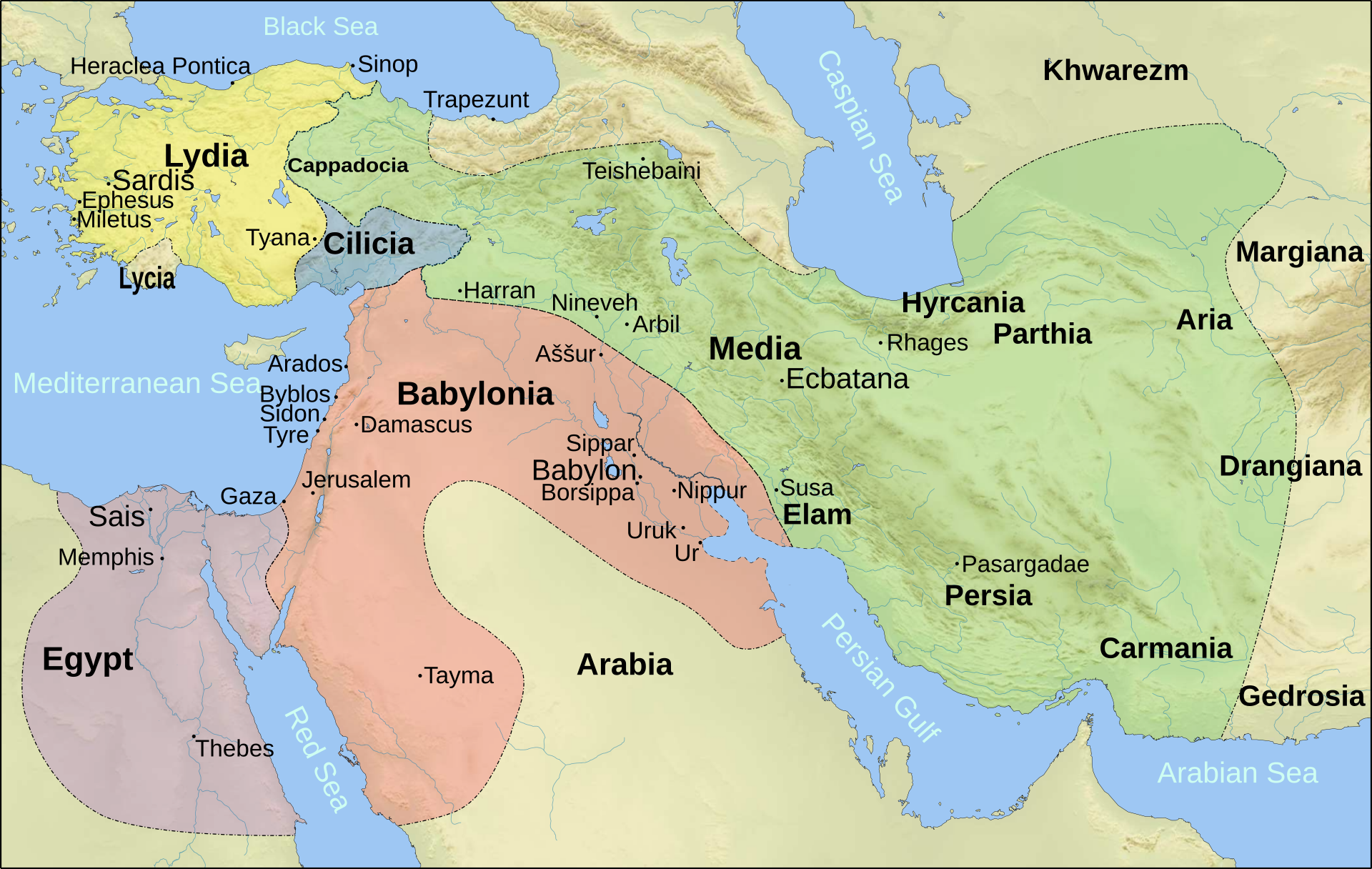 Approximate map of the Median Dynasty[32]
Further into his reign, after 600 BC, Huvaxshathra would fight a brief war with the Babylonians, possibly over contested Assyrian lands, although nothing major would come of it. Sometime around 590 BC, Huvaxshathra would wage a war with many of the remaining Scythians in his kingdom. Flying this offense, many of them would take refuge in Lydia with the protection of its King Walweteś (Alyettes). This would cause a war to break out between the two nations that would last for five years. On May 25th, 585 BC, the two armies would meet in a long and grueling battle that would suddenly stop when a solar eclipse appeared. The two armies, shocked at this sudden occurrence, took this as a sign to stop hostilities and make peace, putting an end to the war. Huvaxshathra would die shortly later in the year, being succeeded by his son Arshtivaiga (Astyages).
Arshtivaiga would rule from 585 until 550 BC until his dynasty was overthrown by his Persian vassal Kurash II (Cyrus the Great). Unfortunately, likely due to this key event, the details of his reign are shrouded in myths and not much is truly known. Presumably he would rule over the Median Empire for 35 years. Arshtivaiga’s greatest legacy is his usurpation by Cyrus the Great, possibly the most famous person in Iranian history today.
The status of Zoroastrianism during the Median Empire is not entirely certain, mainly due to the current lack of archaeology and written sources. At the location of Noushijan, a fortress and fire temple was uncovered, although this was deliberately decommissioned and filled with silt at some point toward the end of the Median Dynasty, perhaps pointing to an as of yet unknown Zoroastrian dispute during this period. Also of note are two territories in Media named after the Avestan nations of Nisaya and Raghi (Ruyi du Ab?), likely formed by immigrants from these nations, with the latter given the modern place name of Ray, Iran. This is of note because in the Avesta, both nations are accused of having great doubt, whether this meant they were atheistic, still followed the Daevic religion, or simply did not accept the Yazata version of Zoroastrianism is hard to discern as of now.[33] Finally, there also developed a type of priest in Media called Magu (Greek Magoi, pl. Magi) who were a class of wealthy, ritual priests who performed sacrifices and interpreted dreams. As of now, not much more is known of the magi, nor of Median Zoroastrianism, at this time.
Achaemenid Dynasty (550–330 BC)
In 559 BC, Kurash II would succeed his father Kambujiya as the King of Anshan and Parsa, nominally a Median vassal. Kurash, a visionary character, had seen a much greater future for the people of Iran. Inspired by Zarathushtrian ideals of a beneficent dominion that united all the people of the world (Xshathra Vairya) within a shared vision of perfecting the world (Frasho-Kereti), he would launch a rebellion against Arshtivaiga in 553 BC in order to establish this new universal kingdom. The war would last for three years, with Kurash being severely outnumbered by the Mada, his own army being significantly less organized and poorly equipped compared to the professional army of Arshtivaiga. It is said he lost three battles, barely managing to keep his army intact against the overwhelming might of the Median army. However, in a fateful event the details of which are lost to us, Kurash would meet with the chief general of the Mada, Arbaka (Hapargus), and convince him of the validity of his vision.[34] At the location of Pasargadae, an important city in Parsa, the Mada and Parsa would once again join battle. This time, Arbaka would turn his forces against Arshtivaiga and deliver him to Kurash in chains, along with the whole of the Median Empire. They would then quickly take the capital Hamgmatana and carry its treasury back to Anshan.
It was at this point that Kurash II would establish the Achaemenid Dynasty of Iran, although he would trace his own dynasty to his great grandfather Cishpish, who was the first Persian King of Anshan. Cishpish himself was the son of a king of the Parsa, Haxamanish (Achaemenes), who ruled at the city of Parsa (Persepolis). Cishpish would go on to capture the ancient Elamite city of Anshan and rule the Parsa and many of the Elamites from this city. He would divide his kingdom among his two sons. To Kurash I, he would give the city of Anshan and its holdings, and to his other son Ariyāramna he would give Parsa and other Persian lands. As such, a split in the family, and in the Persians themselves, would form. One would see themselves as fully Persian, tracing their lineage back to the first king in their family, Haxamanish; while the other, seeing themselves somewhat as a blend of Persian and Elamite, would only trace their lineage to Cishpish, the king who first conquered Anshan. The split between the two, while initially inconsequential, would build until it had larger consequences.
Kurash, now in control of the whole of the former Median Empire, would go on to consolidate his power and make Arbaka his chief general. However, in 547 BC, the king of Lydia, Croessus, would assemble a large army and attack Kurash’s new kingdom, trying to take advantage of the instability. Their first target was the border city of Pteria. Kurash and Arbaka would rush to the defense of the city with a smaller force, but they unfortunately did not reach the city in time, as it was sacked and destroyed by Croessus. They still found the Lydian army there, apparently much larger than theirs, and fought an inconclusive battle that forced the Lydians to retreat to their capital. With winter coming soon, the Lydians thought they could wait for reinforcements from their allies in Greece, but Kurash launched a sudden invasion that forced the Lydians to respond. At the Battle of Thymbra, Arbaka advised Kurash that he should take the camels from his baggage train and place them on the front lines; as the Lydian horses were not accustomed to camels, they were likely to panic. The strategy was a success, and the Parsa would decisively win the battle. They would then quickly capture Sardis. The war only lasted for a few months, and led to the whole of Lydia being incorporated into Kurash’s empire. Croessus himself seems to have been kept as a trusted advisor in Kurash’s court.
After this war, Kurash would go on to fight wars in the East of his empire. It is uncertain if he conquered the Avestan nations in the east or if they were already part of the Mada Empire. In the Archaeology of this region, one sees a shift from Yaz II to III at the time of his reign, which isn’t seen during the Median Empire. This points to the fact he may have integrated them into his empire, which may have been a more peaceful affair based on a shared vision of Iranian identity, given the change in the archaeological culture is incredibly minor. He would go on to conquer the Sogdians and Xwarezmians, Avestan peoples in the far north, before returning back home. Around 540 BC, conflict would break out between the shared border of Iran and the Babylonians, which would lead to Kurash invading the Babylon Empire. He would fight a brutal battle at the city of Opus in the October of 539, where many people died. After this battle the rest of Babylon would fall quickly and relatively peacefully to him. On October 12th, Kurash would enter Babylon with the whole population applauding his entry.
Kurash would go on to rule until 530 BC. After his conquest of Babylon, he would extend his territories all across the ancient world, only stopping at Egypt and Greece. He would move his capital from Anshan to the city of Pasargadae, building a palace, a royal garden, and expanding the city to a much larger size. Within his time, he was able to unite nearly all of the known world under a single vision and governmental system. Rather than rule through fear, oppression, and violence, Kurash chose instead to unite people under freedom, collaboration, and the respect of other people’s beliefs and ways of life. His desire wasn’t to be an absolute ruler who took pride in having power over others, but to provide the world with a singular political identity that could aid in the progression of reality. His vision, and his attempt to actualize it, was one of the most remarkable attempts in human history. Unfortunately, in 530 BC, Kurash II would die in battle, far to the east, deep within central Asia and past the historic lands of the Iranian peoples. Many myths exist regarding this event, including the nature of his death and the very enemy he was fighting. Regardless, his legacy continues on to this day. After his death, Kurash would be succeeded by his son Kambujiya II.
Kambujiya II would rule for a short time, 530-522 BC, and he would expand his father’s conquests to Phoenicia, Egypt, Libya, and Ethiopia. His reign was seemingly not as enlightened as his fathers, as Greek histories paint him as a murderous and temperamental madman who would execute anyone who dared anger him. In 625 BC, Kambujiya invaded Egypt and fought a famous battle at Pelusium. He would go on to take Memphis and spend the next three years consolidating his power in North Africa. His time in Egypt is a somewhat contentious affair; while contemporary records show him doing all the religious duties of a Pharaoh, Greek histories depict his time here as despotic. In 622 BC, certain events would cause him to quickly leave Egypt and return home. On the return journey, shortly after leaving Egypt, his dagger would pierce his thigh while mounting a horse. The wound would quickly become infected, and he would pass away, leaving the realm in an uncertain status.
The history after this point is very uncertain. Not for lack of details however, but due to a very contested succession of power and a narrative in which the difference between what is propaganda and what is truth is hard to discern. What seems to be true is that Kambujiya’s younger brother Bardiya, or someone claiming to be him, would assume rule in Parsa, while a young noble in Kambujiya’s army, Dārayavahush (Darius), would storm Bardiya’s fort in Media and slay this Bardiya with the help of six co-conspirators. He would then go on to proclaim himself the new king of the empire, and put down many rebellions in order to keep the empire intact.
After becoming king, Dārayavahush (here on Daryush) would relate his own narrative of the events on an inscription now known as Behistun. He claimed that shortly before leaving to Egypt, Kambujiya had Bardiya slain and kept this fact from the people. While in Egypt, the land of Parsa would become unrestful, and a certain Magi named Gaumata would claim to be the slain Bardiya and seize the throne. Kambujiya, perhaps rushing on his way to reclaim the throne, would die “his own death”, and the throne would be left in the hands of a deceiver. This false Bardiya would go on to be a tyrant, slaying anyone who had known the real Bardiya so his lie would not come out. Whether this account is true or Daryush, himself hailing from the other branch of the Persian noble lineage, simply saw an attempt to seize power after the death of Kambujiya, is hard to determine. What is true is that after his succession, the empire would very quickly break into open rebellion with there being a very real risk of the newly formed empire fragmenting into pieces.
At first, Babylon and Elam would rise in rebellion, and Darius was forced to put them down. Soon after, the regions of Armenia, Mada, Parthia, Assyria, Egypt, Margiana, and Scythia would open in rebellion. The full, complicated story of this rebellion is related in the Behistun inscription, but important for our story is a few details. Mainly, the most significant and powerful Iranian nations would attempt to break from Persian rule, minus one, Bactria. In Mada, a man named Fravarti, the most difficult of the 9 pretenders Daryush put down, would claim to be king and take the regal name of the founder Xshathrita. The regions of Parthava and Varkana (Hyrcania) would support Fravarti as vassals. Daryush would defeat Fravarti with the help of a general named Vidarna (Hydarnes) while his father Vishtāspa (Hystaspes), who happened to reside in Parthia, would reclaim Parthia.
More significantly for the story of Zoroastrianism, in Margiana, the heart of the Avestan nations, the people would become rebellious and choose a man named Frāda to be their new leader. Daryush had a Xshahtrapaiti (Satrap, a type of governor) in the neighboring nation of Bactria, a Persian named Dadarshi. He would brutally put down the revolt in Margiana, killing 55,000 men in the process. Archaeologically, the Murghab oasis would become heavily depopulated for a number of years. This caused a complete dislocation of the center of Avestan society. The military power would shift to Bactria, centering around the rapidly growing city of Bactria (Balkh). The Avestan language would either go extent as a living language or be entirely eclipsed by its usage as an ecclesiastical language by Zoroastrians all across the empire. Religiously, Zoroastrianism would find new centers in the regions of Bactria, Sistan-Arachosia, Media, and Parsa. During the Achaemenid dynasty, Margiana would continue as a minor, regional center of power under the control of the Bactrians, but after the Achaemenids, Margiana, under the later name of Merv, would gain renewed importance under the Arsacid and Sasanid Dynasties as a major city. After the coming of Islam, Merv would become the largest city in the world and a significant center for science and literature, producing many scientists, poets, and philosophers and having a significant influence on Iranian Sufism and mysticism, perhaps its final gift to the history of religion. When the Mongols invaded, Merv would be completely destroyed and its inhabitants would be systematically slaughtered down to the last person, with ancient sources giving a death toll of 750,000-1,300,000.
Regardless, after securing his empire, Daryush would begin to expand his territory, attempting to conquer the few remaining neighboring states and to eliminate any threat to his empire. In 518 BC, Daryush would invade the modern regions of Pakistan and Northwest India, perhaps continuing an offensive started by Kurash. Following this, Daryush would conquer areas in Anatolia and Northern Greece. Most notable of these was a kingdom named Macedon, which would stay as a Persian Vassal for some time. In this time period, it may even be that certain Classical Greek cities gave Persian diplomats mixed signals of if they would submit to Persian rule. In 513 BC, Scythian raiders to the north of Greece would start to cause problems for Daryush’s new territories. In response he would launch an invasion of Scythian territory in modern day Ukraine. Daryush chased the Scythians all the way to the Dnieper river, but given that the Scythians were nomads who could continue to flee into the steppe, he eventually gave up the chase.
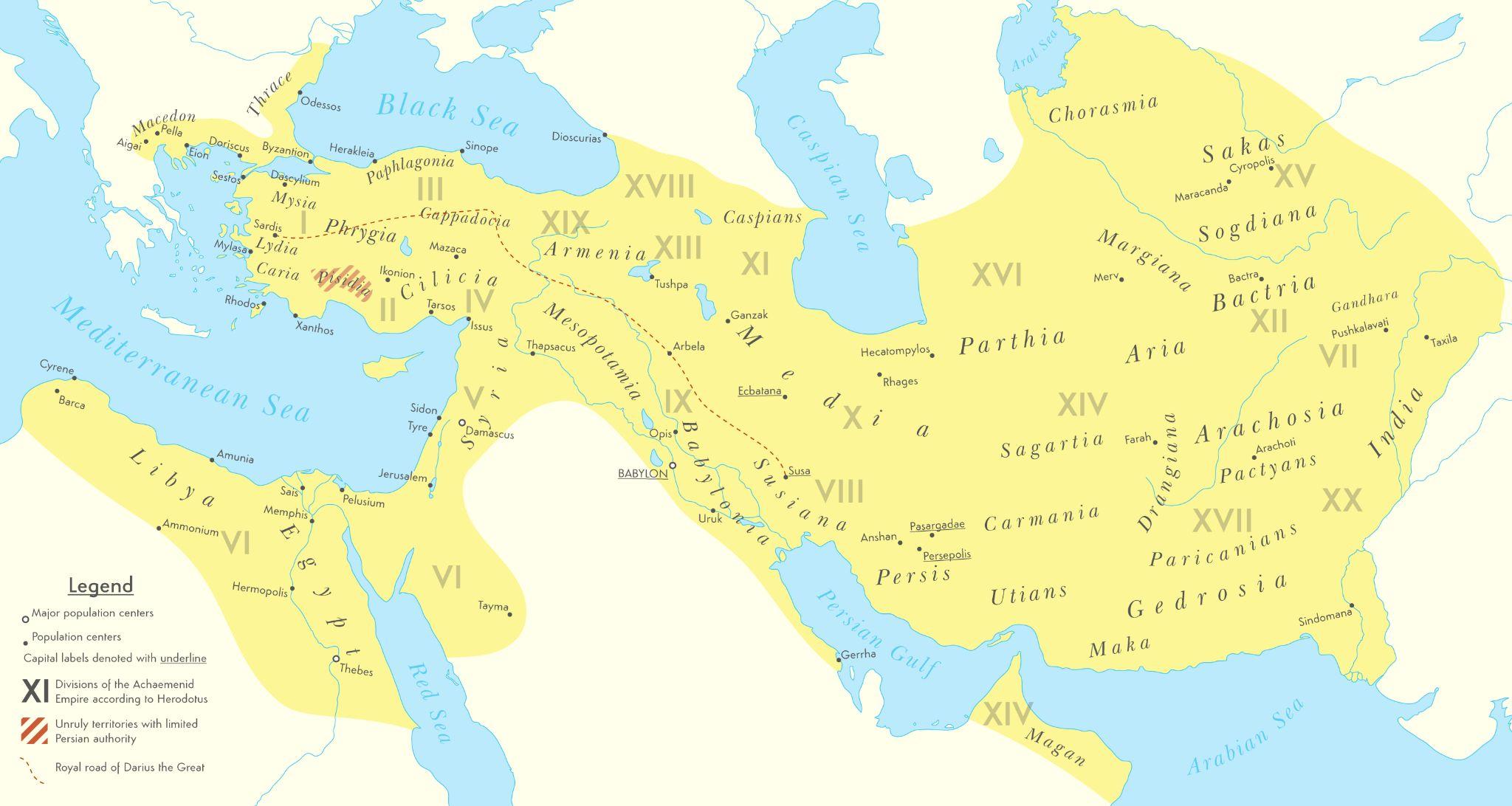
Achaemenid Empire at its height under Darius.[35]
After being at war for ten years since his tenuous assumption of the crown, Daryush would return home to focus on civil affairs. After returning, he instituted an extremely efficient and robust bureaucracy to manage his empire, creating a class of scribes and scholars that would continue to exist even into the Islamic caliphates. The scribes, while likely Persian, initially wrote in Elamite cuneiform, but towards the end of Daryush’s reign, they would switch to Aramaic written on parchment, slowly ending a millennia long tradition of writing on cuneiform. He also embarked on massive building projects. A royal road was built all throughout his empire, connecting Parsa to Egypt, Greece, Bactria, and India; the roads had regular restpoints and guard posts, keeping them accessible and safe for all people of the empire. Most significantly, he would officially make the traditional city of Parsa as his capital and massively increase its size. He would build a massive citadel overlooking the city which is today known as Persepolis. In this citadel, he would build a massive audience chamber and inscribe on the walls all the diverse peoples of his empire. He would also build similar but smaller projects throughout the empire, such as at Susa.
As for Zoroastrianism, Daryush’s reign is somewhat mixed, although he ultimately had a significant effect. In one sense, he oversaw the destruction of Margiana, which, while it would recover eventually, displaced the center of Zoroastrianism; in another sense, he himself was a devout Zoroastrian who facilitated the connection of the disparate Zoroastrian nation and spread Zarathushtrian ideas across the world. In the Inscriptions of Daryush, extending until the reign of Artaxshathra II (404 BC), Zoroastrian concepts like Asha vs. Druj played a central role and Ahura Mazda alone was praised as the creator of the heavens, the earth, man, and even happiness, although they did not go so far to denigrate or reject the gods of their constituent peoples. Most significantly, according to Zoroastrian sources, Daryush would also institute the writing down of the Avesta onto 1200 cowhides;[36] although, at this time, it would have been a library of different Avestan texts, rather than a canonized scripture. Most likely, an alphabetic script was innovated from Aramaic, similar to Daryush’s creation of Old Persian cuneiform. In his time and after, Avestan texts would continue to be created and recited. The oral recitation, or ‘pure speech’, would still be the preferred and most prestigious method, especially for the oldest and most significant texts, but the written tradition would accompany it.
Of the Avestan material created in this time period,[37] it is possible the Spand Nask and Vishtāsp-sāst Nask were composed in this time period. These books were both epic narrative poems each having 60 chapters of ~43 stanzas of ~8 lines, likely totalling ~20,000 lines each. The Spand Nask was a mythical narrative of Zarathushtra’s life, along with the history of the religion before and after him; similarly, the Vishtasp-sast was likely a narrative of Zarathushtra’s mission to convert Visthaspa, the war with the Xyonians, and the history of the rulers of Iran before and after Visthaspa. Less certain are the Avestan books of the Barish and Kaykashraw, which are the only other Avestan books to have 60 chapters. Another potential is the Damdad, a creation narrative which contained accounts of geography, taxonomy, myth, and history. Finally worth noting is the Warsht-mansr nask, a parallel piece to the Gathas which used myths related to Zarathushtra’s life to teach religious lessons. It is likely that other books were created during this time, particularly ones that wouldn’t survive past Alexander.
Both Kurash’s and Daryush’s reign would institute a period of Zoroastrianism which would go on to define the rest of Zoroastrianism in the Achaemenid period. After the destruction of Margiana, the core of Zoroastrianism would be geographically decentered and spread across the empire. In the east, the Avestan regions of Bactria and Arachosia would become major centers of Zoroastrianism, both the major cities of Balkh and Kandahar being core centers of the religion. In the west, Parsa and Mada would play major roles as the continuers, standardizers, and spreaders of the religion. Zoroastrianism would directly spread to Armenia, where it combined with traditional religion in a syncretic mixture. The religion would also go on to heavily influence Judaism during the second temple period, aiding them in transforming YHWH/Elohim from a regional henotheistic deity to the everpresent and transcendent creator of the universe. In Greece, Zoroastrian ideas, including Gathic concepts, would heavily influence the philosophical movement, most notable in Plato’s dialogue of Timaeus. In the region of Bactria, a religion very similar to the traditional Avestan religion would continue, while in Arachosia and Drangiana, it seems possible although not certain, that a particular dualistic form of Zoroastrianism would form, casting Angra Mainyu as Ahura Mazda’s direct adversaries. The shape of the religion in Parsa and Media during the Achaemenid Empire specifically is not certain, although it seems more than likely that being at the center of a global empire that many different ideas and interpretations proliferated. The dualist version of Zoroastrian mentioned before would begin to take increased relevance across the empire, especially in Parsa, where centuries later it would become the standard version of Zoroastrianism in the Sassanid dynasty, even continuing to be the preconceived notion of Zoroastrianism to many in the modern day.
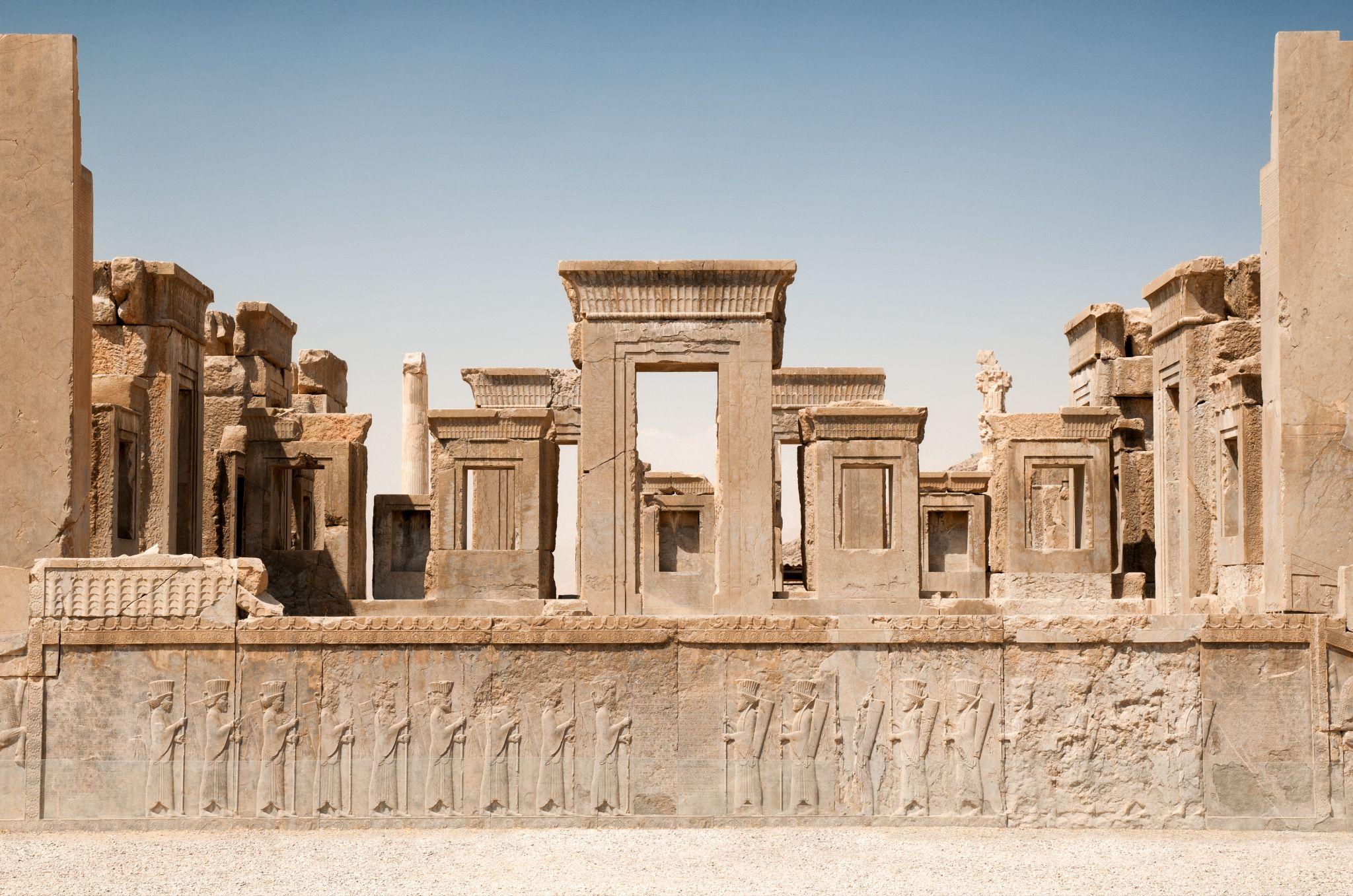
Tachara building at Persepolis.[38]
The end of Daryush’s reign would see a massive rebellion that would go on to define the image of Persia in western minds. In Anatolia, there existed many Greek cities on the western coast, known as Ionia, that had been subjugated by Kurash and Arbaka around 540 BC. In place of their democracies, they were given hereditary rulers, known to the Greeks as tyrants. Over roughly 4 decades, the Ionians suffered under the rule of these rulers, until they began to rebel. These cities would enlist the help of the wealthy and powerful Greek cities, most notably Athens. In 498 BC, they would attempt a siege of the regional capital Sardis, which, while unsuccessful in taking the city, succeeded in burning much of it down. While the revolt would be put down in 493, Daryush and his generals saw it necessary to now deal with the threat of Greece. In 492 BC, a relative of Daryush, Marduniya (Mardonius), launched an invasion of Greece, primarily naval. While initially successful to some extent, the Persians were constantly beset by difficulties, mainly from the fact that they were not sailors. According to some sources, a whole fleet would be caught in a storm and destroyed, killing tens of thousands and postponing further advancements. In 490 BC, Daryush would entrust the Median general Datiya (Datis) with the task of leading another invasion. This invasion found more success, taking many islands and getting close enough to threaten the city of Athens. However, at the marshy bay of Marathon, the Athenians and their allies would force the Persians into a ground battle where their elite cavalry could not be deployed. The Greeks dealt the Persians a massive defeat, forcing the survivors to board their boats and retreat back to Anatolia.
After this failed invasion, Daryush would plan to assemble a massive army to subjugate the Greeks, but a revolt in Egypt would distract him in the middle of his war preparations. He would successfully put down this revolt, although in the process he would contract some form of illness, ultimately proving fatal. He would die in the October of 486 BC, being entombed at the site of Naqsh-e Rostam, in the vicinity of Persepolis. In his time, Daryush had succeeded in bringing the Iranian Empire back from almost complete collapse and balkanization. Moreover, he also entirely reorganized the empire, transforming it from a collection of states under a single king, to an incredibly efficient empire, with a robust economy, currency, and network of roadways. While not as much of a conqueror as Kurash or Kambujiya, he would still incorporate new territory in India and Greece. He also crafted a single identity and aesthetic for the empire at places like Persepolis and Nowruz, giving the people of his empire a distinct imperial iconography and identity in order to unify and inspire them. Most importantly, he was the one responsible for transforming the vision of Kurash from merely a conquest of territories into a fully actualized, well-honed bureaucratic system uniting nearly the whole known world. This system of bureaucracy would perhaps be Daryush’s most enduring, directly carrying on from his own empire into successive ones in the middle east (extending to the Ottomans, Safavids, and Mughals) and likely heavily influencing the bureaucratic systems of Greece and Rome. In later Iranian tradition, it would be Daryush that would be greater remembered, rather than Kurash or even Huvaxshathra, as he was the one who turned their kingdom into a system that would live well on past him, regardless of which ruler or ethnicity sat at the top.
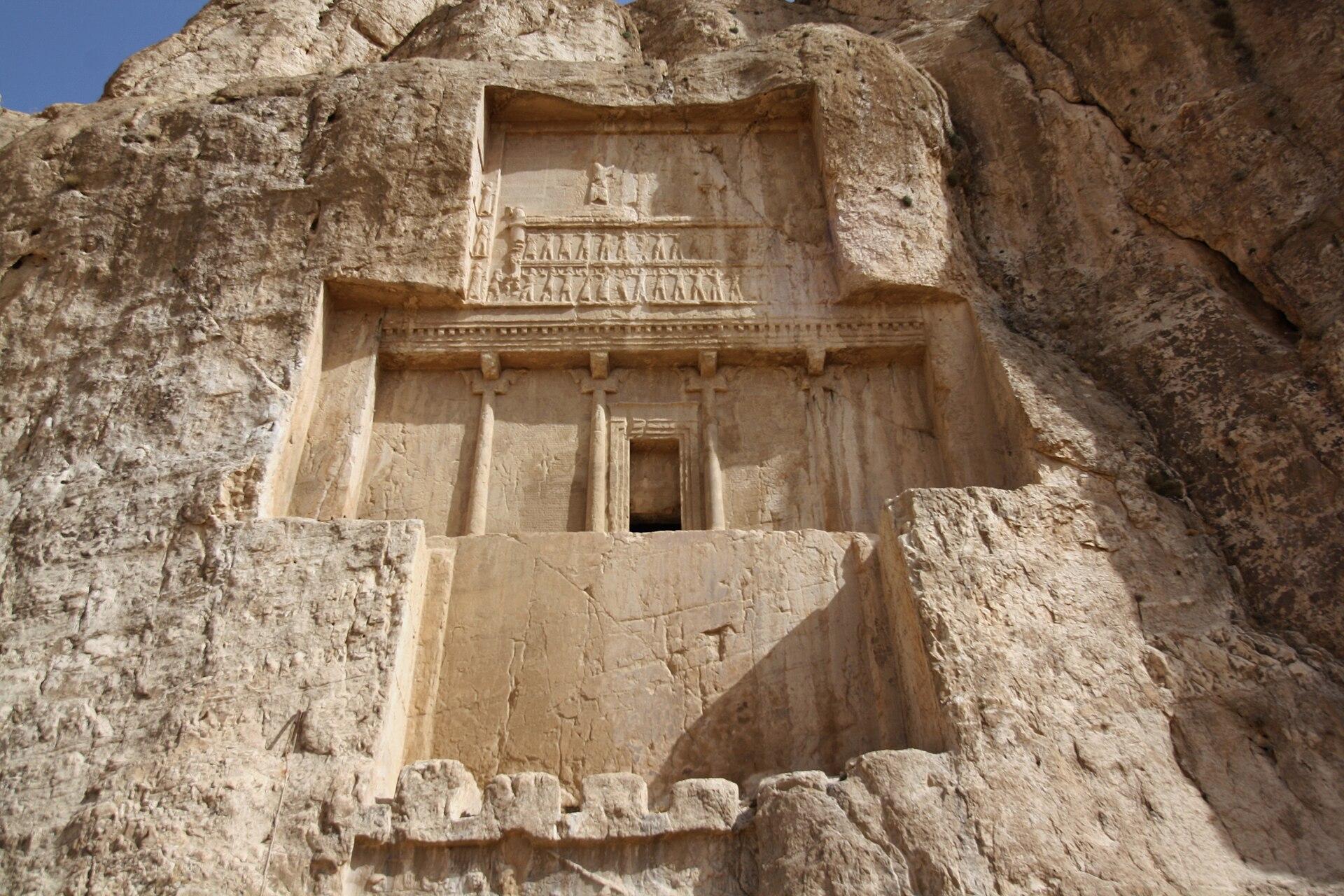
Tomb of Darius at Naqsh-e Rostam.[39]
The reigns of Cyrus and Darius can be seen as the culmination of the Iranian project and the universal vision that Zarathushtra had some 700 years prior. With a few notable exceptions, the entire known world had been unified under a single, pluralistic governmental system. Roads and bureaucratic systems had been built that would live on for thousands of years. Science, technology, philosophy, and the overall level of thought in the world had been drastically elevated. Human living conditions and civilization had been greatly improved. Rather than assimilating civilization they encountered into a Persian or Iranian culture (as with the Macedonians, Romans, or Arabs), they instead celebrated the diversity of their empire. The empire was universal, pluralistic, and generative, despite its flaws.
This attempt at a universal dominion, aimed at working towards the perfection of the world, is the greatest legacy of these two individuals. Cyrus, similarly to Zarathushtra, entered a world full of aggression and oppression, where small polities endlessly fought against each other for wealth and glory, with many innocent people caught in the middle. He instead saw a better path, a unification of the world and an establishment of Zarathushtra’s desirable dominion, a kingdom based on the support of the common people. And so he established it, uniting a world that had never been united before, rarely (or never) initiating a conflict. Darius, the more pragmatic of the two, saw that, despite Cyrus’ noble intentions, the implementation of any such grand vision required a system just as complex and grand, that the actualization of any idea was often much more complicated and messy than anticipated, and that often one may have to make many compromises to achieve such a goal. As such, he took Cyrus’ conquests, and vision, and ensured it would live on.
While the empire would last for another 150 years after Darius, with other Dynasties of the Iranian Empire lasting another thousand years, this would be the closest Iran got to that vision in its purity. The Achaemenid Dynasty would eventually become embroiled in border wars and court intrigue before its conquest in 330 BC by Alexander, whose untimely death led to the very balkanization Darius prevented. The Arsacid and Sasanid Dynasties would eventually reclaim the empire, but they would be more removed from the comprehension of the Gathic message, and saddled with the baggage of Alexander’s conquest and destruction. Towards the end of the Sasanid Dynasty, it seems a growing intellectual movement led to a minority of the population returning to the Gathas as their only religious texts, perhaps influencing the political and religious reforms of Mazdak, which sought to implement a socialistic governmental system in Iran and to get de-institutionalize the wealthy ritualistic priests.
Regardless, at this point in history, Zarathushtra’s vision had been realized, at least in part… a noble attempt, way ahead of its time, seeking to perfect the world. Nearly a thousand years had gone by since Zarathushtra had first seen a better path for the world. He was the first, and perhaps only person in the world who had been able to communicate at length with the transcendent creator of the universe, to receive the truths of the metaphysical nature of existence. Not only had he been shown the truths of the universe–its beginning, true nature, and the existence of its creator–he had also been shown the underlying order that governed existence, the best things contained within, and how the world could be greatly improved if only these things could be implemented. However, he himself seemed skeptical that the world would ever be capable of enacting it, as he indicates in Yasna 43.
43.11c-d
hiiat̰ xšmā uxδāiš dīdaiŋ́hē paōuruuīm
sādrā.mōi sąs maṣ̌iiaēšū zarazdāitiš
tat̰ vərəziieidiiāi hiiat̰ mōi mraōtā vahištəm
When I was first taught by Your words
Painful it appeared to me, my faith in humanity
To actualize that which Ye have told me is best.
Today, about 3500 years after Zarathushtra and 2500 years after Cyrus and Darius, the world has yet to see Zarathushtra’s vision come to fruition, his teachings nearly lost and incredibly obscure. His vision, while still living on in some sense in the modern world, has only further shrunk from the public consciousness. The world, and especially Iran, still hasn’t learned how to implement his vision. The system of thought he gave, which would enable humans to iteratively work towards perfection, is now obscure and typically misunderstood. Still, the truths that he discovered are still true, if one so chooses to believe that, and such truths can never be fully eradicated. They will eventually be rediscovered, and molded to fit the context of their times, and environment. In a sense, the Gathic message lives on in all who seek to understand the workings of the world, and to use this to enact a better, more ideal existence. This, one may hope, is the true legacy of Zarathushtra, and the Zoroastrian religion which he founded.
**************************************
-
This article is an early draft and some changes may come in the future. Large parts of it, especially in the Pre-Median section, are based on original research of mine. Due to the medium, this article is intended for the lay person, and does not quite reach a level of academic rigor, although many of the arguments may appear in academic material I write in the future. ↑
-
The largest amount of this section comes from the comparison of Denkard 7 and the Selections of Zadspram with the Gathas. Both these sources seem to be drawing on the Avestan book of the Spand Nask (especially Denkard 7, which reads as a part by part summary of the book). The Spand, from what I can tell, was semi-historical about the life of Zarathushtra, but seemed to have a historical section on the period after him. ↑
-
See Lhuillier Cultural Diversity and Evolution of Ceramic Production during the Pre-Achaemenid and Achaemenid Periods in Central Asia and The Settlement Pattern in Central Asia during the Early Iron Age although the literature on the topic of Yaz is vast and, unfortunately, often extremely narrow in focus. ↑
-
Cf. Hale Asura in the Early Vedic Religion. I interpret asura in the many quotes he supplies and ahura in its many uses in the Gatha to represent a specific Indo-Iranian theological term which indicated the supremacy of a divine being, hence my usage of supreme in certain contexts. I plan to write more on this in the future. The archaic meaning is indeed lord, but I feel this often misses the context of its usage. ↑
-
See Schwartz and Flattery: Haoma and Harmaline. ↑
-
The root of this word is PIE *(s)kewh₁ ‘to percieve’ with cognates in English show, German schauen. ↑
-
Franz Grenet An Archaeologist’s Approach to Avestan Geography, in which he places it in Ragh Afghanistan. ↑
-
The Avestan historical account of the religion in the Spand Nask only survives in a poor summary in Denkard 7.7 where the narrative is conflated with Sassanid history. Some archaeological evidence of a brief decline in Yaz II, including the burning of Ulug Depe, leads to a tentative identification of 278 years before ~900. While the Spand originally had a precise chronology dating from the birth of Zarathushtra, there is room to doubt if they remembered the precise date of Zarathushtra. ↑
-
I am unsure of these three Avestan names as of now. ↑
-
Av. daе̄nā ‘envisionment’. The fact of him attending a school for manthrans/priests (besides the technical mastery in the Gathas) is Selections of Zadspram 20.14-16 in which I see a much larger underlying source, although my overall assertion here may be spurious. ↑
-
Yasna 32.3 at̰ yūš daēuuā vīspā̊ŋhō akāt̰ manaŋhō stā ciθrəm ‘But you all gods are clearly spawn from the bad mind’ and 49.4 tōi daēuuə̄ṇġ dąn ẏā drəguuatō daēnā ‘they created the daevas which is the envisionment of the deceitful’. ↑
-
Denkard 7.4.67, slightly adapted from E. W. West’s translation (Marvels of Zoroastrianism). The Pahlavi text here highly suggests it was directly translated from Avestan, specifically an octosyllabic octave. ↑
-
Vishtasp Yasht 43 ↑
-
Vishtasp Yasht 36 ↑
-
This account is also found in Pahlavi Rivayat 47, which is following the Spand supplying some details not found in Denkard 7. ↑
-
This dating system is evidenced in Denkard 7.7 and Zapdram Chapter 23, although without the original material it is impossible to know its start date. ↑
-
See Schwartz How Zarathushtra Generated the Gathic Corpus ↑
-
This is an assumption of mine based on the usage of Gatha in related languages; it may not be true. ↑
-
Avestan/Pahlavi legend notes three sons, Isat.vastra ‘wished for pasturage’(?), Urvatat.Nara ‘the manly vow’, and Hvare.cithra ‘descendant of the son’; the first represented the class of priests and will preside over the final accounting of the every deed; the second represented the class of farmers and rules over an eternal underground city made by Yima; the third represents the warriors, and would lead the final battle at the end of time. These sons are obviously mythical and likely made to correspond with the three Saoshyants at the end of time. The Avesta also notes three daughters, Freni, Thriti, and Pouruchista. In the selections of Zadspram Freni and Thriti are noted as playing an important role in the decades after Zarathushtra’s death, which seems more probable, although the identity of Thriti (‘the third’) may have been an invented daughter to balance with the three sons. The common name of Freni among early saintesses in Zoroastrianism leads credence to her existence in comparison to the other children. Zarathushtra’s wife hvovi, feminine of hvova, YAv for Hvogva, sounds more mythological, and the “other two wives” again gives Zarathushtra three wives for his three sons and three daughters. ↑
-
See Martin Schwartz Gathic Manaroish: A Hapax Expatiated Compositionally for an introduction to the complex system of interconnected composition in the Gathas ↑
-
This story can be found in the Memorials of Zarer, which also gives evidence of an underlying octosyllabic Avestan poetry. It may have been drawn from the Spand or Wishtasp-sast Nasks. ↑
-
In Denkard 7.7, and likely in the underlying Zand of the Spand, this event is conflated with Alexander’s invasion of Iran leading to the modern misconception of Zarathushtra being born 278 years before Alexander. Also see fn 23. ↑
-
See Monier-Williams entry for amrita (Sanskrit equivalent to Amesha) with the meaning of ‘a collective body of immortals’ in the Rigveda. ↑
-
For the burning of Ulug Depe see Bendezu-Sarmientu Ulug Depe a forgotten city in Central Asia, for Yaz IIa and IIb, see Boroffka and Sverchkov The Jaz II and III period pottery. ↑
-
Both photos are from Lhuillier, Dupont-Delaleuf, Lecomte, and Bendezu-Sarmiento The Middle Iron Age in Ulug-depe which source the photos from other publications. There exist other cities with citadels in Yaz culture (such as the eponymous Yaz Depe), but I have yet been able to find photos. ↑
-
Appearing as Haroya in Vendidad 2 due to Young Avestan phonetic rules. ↑
-
Herodotus 1.131 gives a very interesting account of Persian religion, saying that they only worshiped the whole firmament of heaven, calling it Zeus (i.e., Ahura Mazda), alongside the natural world, and that they only later learned the worship of *Anahita and Mithra. This account seems to indicate they initially followed a Gathic style of the religion before adding Anahita and Mithra, which is also indicated in Achaemenid inscriptions. ↑
-
See Dandamaye and Medvedskaya Media on Encyclopedia Iranica for a discussion on the history and dating of the Median Kingdom. ↑
-
Pg. 488 Mathews and Fasli The Archaeology of Iran from the Paleolithic to the Achaemenid Empire. ↑
-
Darayavahush in the Behistun inscription states that the rebel Fravarti, who claimed the regnal name of Xshathrita, asserted himself to be of the lineage of Huvaxshathra, not of Dahyuka or Xshathrita. This seems to indicate that either R̥štibara was not a descendant of Xshathrita or that there was enough of a disconnection between the two (due to the Scythian interregnum) that the identity of a distinct royal lineage was unable to form. ↑
-
source: https://commons.wikimedia.org/wiki/File:Median_Empire-en.svg ↑
-
See Vendidad 1.7 and 15. cf. Yasna 19.18 where Raghi is described as not having a ratu presiding over the whole nation. For the form Raghi against Raghā, see Cantera and Redard pg. 141. ↑
-
All we know is that Arbaka defected to Kurash II, no details of how or why this happened are known. ↑
-
source: https://commons.wikimedia.org/wiki/File:Achaemenid_Empire_500_BCE.jpg ↑
-
This is according to the letter of Tansar, which, if this section of the letter indeed is part of the original letter, is a remarkable historical detail. Independently, I have found a few letters in Avestan that must be traced back to Aramaic, rather than Pahlavi, such as u, c, g. ↑
-
Given that 85% of the Avesta is missing, it is hard to date missing books with any certainty. Against my argument here, it is also plausible that the Achaemenid reign saw the switch of Avestan peoples to writing, with only older material being continued to be recited for posterity. This may be why existing Avestan material, being perhaps the only stuff which survived Alexander, bears no noticeable references to the Achaemenids or Medians, although there is a chance some of the missing material bore these references. ↑
-
source: https://commons.wikimedia.org/wiki/File:2018-09-21_Iran,_Persepolis,_Tachara_%28from_the_southeast%29.jpg ↑
-
https://commons.wikimedia.org/wiki/File:Tomb_of_Darius_I_@_Naqsh-e_Rustam_%2819501521136%29.jpg ↑


Theo Kapur

Caleb Goodfellow is a graduate student of ancient Iranian languages, mainly Avestan and Pahlavi. His research interests include the Gathas of Zarathushtra, the missing books of the Avesta, and the history of the Avestan people. However, his greatest passion is the philosophy of Zarathushtra, and he has made it his mission to uncover the true depth of meaning in the Gathas and spread this nearly lost knowledge to the world.